SIID Business R&D – Demonstration Projects (Individual & Collaborative)

The SIID Business R&D – Demonstration Projects programme supports companies that have already completed successful R&D activities and are now ready to validate and demonstrate innovative technologies, products, processes or services in real operating conditions before commercialisation. The objective is to accelerate market adoption, reduce technology risk and strengthen the commercial potential of innovation.

Programme details

  • Call reference: MPr-2026-07
  • Application period: 14/07/2026 to 29/12/2026 (17:00)
  • Eligible beneficiaries: SMEs and Small Mid Caps (individual projects or collaborative projects with research organisations)
  • Type of support: Non-refundable grant
  • Maximum support intensity: Up to 80% of eligible costs (up to 85% for eligible research organisations in collaborative projects; 40% maximum for projects in the Lisbon region)
  • Minimum eligible investment: €200,000
  • Maximum project duration: 18 months
  • Geographical scope: Mainland Portugal (COMPETE 2030 and Regional Programmes)
  • Indicative budget: €12.5 million


SIID Business R&D – Demonstration Projects (Individual & Collaborative)


About the incentive

This programme is designed for companies that have already developed innovative technologies and need to demonstrate their technical and commercial viability before large-scale market deployment.

Projects should focus on validating innovations in real-life environments through pilot installations, demonstrators or advanced prototypes capable of proving the technology to potential customers, partners or investors. Clinical and biomedical demonstration projects, including Phase I and II clinical trials, are also eligible.

Eligible investments

The programme supports a wide range of R&D demonstration costs, including:

  • Technical personnel dedicated to the project
  • Prototype, pilot and demonstration equipment
  • Technical and scientific consultancy
  • Software, patents and intellectual property
  • Materials and specialised equipment
  • Certification and validation activities
  • Dissemination and demonstration events
  • Indirect costs through a 7% flat rate

Who can benefit?

This incentive is particularly suitable for companies that:

  • Have completed R&D activities and are approaching commercialisation
  • Need to validate innovative technologies under real operating conditions
  • Are preparing to scale new products or processes
  • Want to strengthen the market credibility of their innovation before launch
  • Plan to collaborate with universities or research organisations on demonstration activities

Projects focused solely on early-stage research are generally less suitable, as the programme targets technologies that have already achieved a significant level of technical maturity and require industrial or market validation.

Need More Information?

Understanding the rules and eligibility criteria of each instrument is essential to assess its relevance and potential impact within a company’s broader investment and financing strategy. For clarification or further information, reach out through our contact form.

Oporto Accounting Joins INOVAGAIA’s One Stop Shop Workshop on Starting a Business in Portugal

[et_pb_section fb_built=”1″ _builder_version=”4.16″ global_colors_info=”{}”][et_pb_row _builder_version=”4.16″ background_size=”initial” background_position=”top_left” background_repeat=”repeat” global_colors_info=”{}”][et_pb_column type=”4_4″ _builder_version=”4.16″ custom_padding=”|||” global_colors_info=”{}” custom_padding__hover=”|||”][et_pb_text _builder_version=”4.27.4″ text_font=”Radikal|300|||||||” text_line_height=”1.9em” header_2_font=”Radikal||||||||” background_size=”initial” background_position=”top_left” background_repeat=”repeat” hover_enabled=”0″ inline_fonts=”Radikal” global_colors_info=”{}” sticky_enabled=”0″]

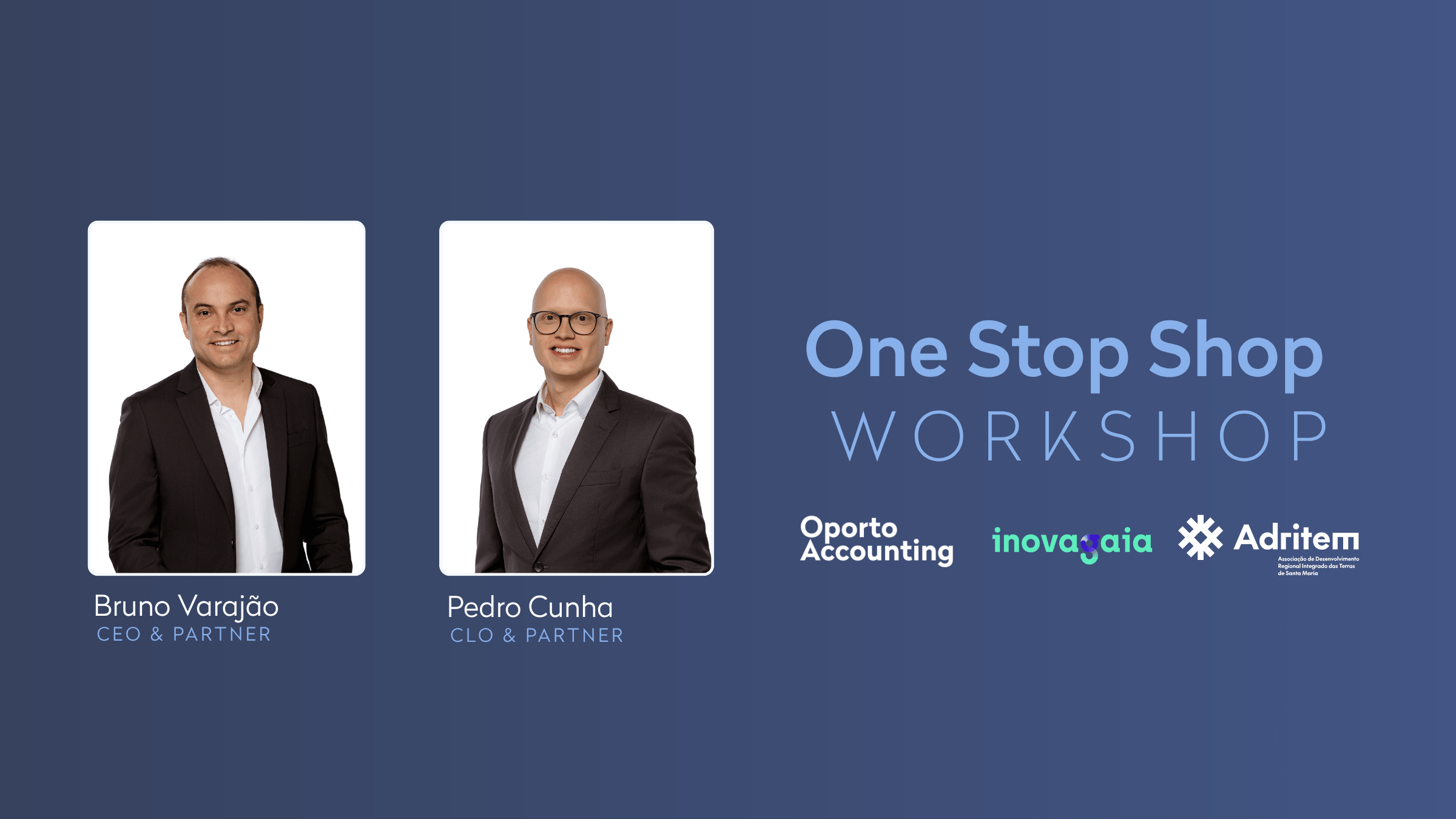
Oporto Accounting was pleased to take part in the One Stop Shop Workshop, an initiative designed to support immigrant entrepreneurs and individuals interested in starting a business in Portugal. The workshop was organised by our long-standing partner INOVAGAIA, in collaboration with ADRITEM – Associação de Desenvolvimento Regional Integrado das Terras de Santa Maria, as part of the Centraliza + One Stop Shop project, with the support of Montepio and other strategic partners.

The One Stop Shop initiative promotes the economic and social inclusion of immigrants across Northern Portugal by bringing together access to entrepreneurship support, financial literacy, mentoring, training and business development services.

Oporto Accounting’s CEO, Bruno Varajão, and Chief Legal Officer, Pedro Mendes da Cunha, shared practical insights into the key legal, tax and accounting considerations for anyone planning to start a business in Portugal. The session covered how to choose the most suitable legal structure and register a business or self-employed activity, including the main requirements, registration process, expected costs and the practical differences between the available legal frameworks.

We also explored Portugal’s tax system and the ongoing accounting and tax obligations that entrepreneurs face, including key taxes, reporting requirements, important deadlines, and best practices to help businesses remain compliant from day one. Throughout the session, our aim was to provide clear, practical insights that participants could confidently apply as they begin and grow their entrepreneurial journey in Portugal.


Our goal was to help participants gain a clear and practical understanding of the legal and tax aspects of entrepreneurship, giving them greater confidence to start and grow their businesses in Portugal.

At Oporto Accounting, we are proud to support initiatives that promote financial literacy, entrepreneurship and the sustainable development of local communities. We believe that sharing knowledge is one of the best ways to help build a stronger, more inclusive and resilient economy.

For further clarification on company setup or accounting in Portugal, you can reach out through our contact page.

[/et_pb_text][/et_pb_column][/et_pb_row][/et_pb_section]

Porto Startup Ecosystem Strengthens Its European Position

[et_pb_section fb_built=”1″ _builder_version=”4.16″ global_colors_info=”{}”][et_pb_row _builder_version=”4.16″ background_size=”initial” background_position=”top_left” background_repeat=”repeat” global_colors_info=”{}”][et_pb_column type=”4_4″ _builder_version=”4.16″ custom_padding=”|||” global_colors_info=”{}” custom_padding__hover=”|||”][et_pb_text _builder_version=”4.27.4″ text_font=”Radikal|300|||||||” header_2_font=”Radikal||||||||” background_size=”initial” background_position=”top_left” background_repeat=”repeat” hover_enabled=”0″ inline_fonts=”Radikal” global_colors_info=”{}” text_line_height=”1.9em” sticky_enabled=”0″]

Porto’s rise as an international business destination has been building for years. What was once recognised primarily for its industrial heritage and quality of life is now gaining increasing attention as one of Europe’s most attractive cities for startups, technology companies, and international investment.

The latest Global Startup Ecosystem Report 2026 (GSER) recognises Porto as one of the world’s fastest-growing emerging startup ecosystems. This reflects the city’s ability to create the conditions that innovative businesses need to launch, scale, and succeed.

This progress is the result of long-term collaboration between universities, research centres, public institutions, investors, accelerators, and the private sector. Together, they have transformed Porto into an increasingly competitive location for companies looking to establish a presence in Europe.

For international entrepreneurs, Porto offers much more than a dynamic startup community. The city combines access to highly qualified talent, competitive operating costs, modern infrastructure, and direct access to the European Single Market. At the same time, Northern Portugal continues to strengthen its role as one of the country’s main economic engines, offering opportunities across technology, manufacturing, life sciences, renewable energy, and other high-value industries.

This balanced and sustainable approach is one of Porto’s greatest strengths. The city has focused on building an ecosystem capable of supporting businesses throughout every stage of their development, from innovative startups to international companies establishing subsidiaries, branches, or regional operations in Portugal.


Financial Stability Reinforces Investor Confidence

A strong business ecosystem also depends on long-term confidence.
Alongside its growing international recognition, Porto continues to demonstrate solid financial fundamentals that support sustainable economic development.

In June 2026, Fitch Ratings affirmed the City of Porto’s ‘A’ Long-Term Issuer Default Rating with a Positive Outlook, recognising the municipality’s prudent financial management, strong operating performance, and sustainable debt profile.

For investors and business leaders, this is a signal that Porto offers a stable and well-managed environment in which businesses can invest with confidence.

As more businesses look beyond Europe’s largest capitals for growth opportunities, Porto continues to stand out for the qualities that matter most: innovation, talent, stability, connectivity, and a business-friendly environment for long-term investment and sustainable business growth.

For further clarification on company setup or investment in Portugal, you can reach out through our contact page.

[/et_pb_text][/et_pb_column][/et_pb_row][/et_pb_section]

Employment Creation and Micro-entrepreneurship — CIM Cávado

[et_pb_section fb_built=”1″ _builder_version=”4.27.4″ width=”98%” max_width=”100%” global_colors_info=”{}”][et_pb_row _builder_version=”4.16″ background_size=”initial” background_position=”top_left” background_repeat=”repeat” global_colors_info=”{}”][et_pb_column type=”4_4″ _builder_version=”4.16″ custom_padding=”|||” global_colors_info=”{}” custom_padding__hover=”|||”][et_pb_text _builder_version=”4.27.4″ text_font=”–et_global_body_font|300|||||||” ul_font=”–et_global_body_font|300|||||||” background_size=”initial” background_position=”top_left” background_repeat=”repeat” global_colors_info=”{}”]

Support for local micro-entrepreneurship operations through the expansion of micro and small companies and the creation of new jobs in social economy entities. This call applies to the NUTS III Cávado region and aims to promote employment, reduce labour precariousness and support the economic and social development of the territory.


Programme Details

  • Call reference: NORTE2030-2026-15
  • Application period: From 01/07/2026 at 18:00 to 30/09/2026 at 18:00
  • Eligible beneficiaries: Micro and small companies with an establishment in NUTS III Cávado and social economy entities
  • Type of support: Non-refundable grant
  • Support rate:
    75% of eligible costs for projects located in low-density territories
    65% of eligible costs for projects located in other territories
  • Maximum number of applications: 1 application per beneficiary
  • Maximum number of supported jobs: Up to 3 new jobs
  • Maximum operation duration: Up to 36 months, subject to the applicable support period for each job
  • Geographical scope: NUTS III Cávado
  • Funding programme: Programa Regional do Norte 2021-2027 — NORTE 2030
  • Indicative total allocation: €1,112,964.29
  • Allocation for companies: €445,185.72Allocation for social economy entities: €667,778.57


About the Linha Fomento IFIC Mais

The Employment Creation and Micro-entrepreneurship — Cávado Intermunicipal Community (CIM) call supports the creation of new jobs linked to the expansion of existing companies or to the reinforcement of activity by social economy entities.

For companies, the support is aimed at micro and small companies that already have activity in the region, have submitted IES 2025 and have economic activity recorded in 2025 under the CAE relevant to the project.

Freelancers and liberal professionals are not eligible, as they are not considered eligible company legal forms for the purposes of this call.

Supported jobs must be:

  • Created after the application is submitted;
  • Based on a permanent employment contract;
  • Full-time;
  • Located physically in an establishment, branch or stable delegation in NUTS III Cávado;
  • Associated with net job creation by the beneficiary entity.

How it works

The support is calculated using a Simplified Cost Options methodology. The total eligible cost corresponds to the eligible direct personnel costs, calculated through a unit cost, plus a fixed rate of 40% to cover other eligible costs related to the operation.

In practical terms:

  • Total eligible cost = Eligible direct personnel costs x 140%
  •  The grant covers 75% or 65% of that amount, depending on the project location
  • The beneficiary must secure the private contribution of 25% or 35%

An initial 10% advance payment may be requested after approval, provided that the acceptance term has been signed, the tax and social security situation is regularised, the IBAN is validated and the start of the operation is evidenced through the first eligible employment contract.

The remaining support is paid through reimbursement requests and the final balance.

Applications are assessed under the NORTE 2030 eligibility and selection criteria, including the socio-economic and environmental value of the project and its effectiveness and efficiency. Only applications with a final score of at least 3.00 points may be considered for ranking and funding, subject to the available budget.


Eligible activities

The call is limited to specific economic activities, and there must be evidence of activity and turnover in IES 2025 under the relevant CAE.

Eligible activities include:

  • Extractive industries;
  • Manufacturing industries, with specific exclusions;
  • Accommodation and food service activities, only in low-density territories;
  • Research and development — CAE 7210;
  • Education;
  • Human health and social work activities;
  • Arts, sports and recreational activities;
  • Other eligible service activities.

Main conditions to consider

To be eligible, the company or entity must meet several requirements, including:

  • Having organised accounting or an adequate accounting system;
  •  Demonstrating a balanced economic and financial situation;
  • Meeting the minimum financial autonomy requirement of 10% for companies;
  • Demonstrating capacity to finance the operation;
  • Ensuring net job creation;
  •  Maintaining all supported jobs until three months after the end of the operation;
  • Ensuring that the jobs are performed in person and located in NUTS III Cávado.

Remote, online, hybrid or distance working arrangements are not eligible. Virtual incubation is also not eligible.

Jobs held by managers, directors, shareholders or persons who had an employment or management relationship with the company in the 12 months before the application are also excluded under the rules of the call.

Who can benefit

This incentive is particularly relevant for micro and small companies already established in the Cávado region that are planning to expand their activity through local hiring.

It may be suitable for companies that:

  • Need to strengthen operational or technical teams;
  • Have an active physical establishment in the region
  • Operate under an eligible CAE;
  • Can demonstrate net job creation;
  • Have the financial capacity to cover the private contribution;
  • Plan to hire eligible workers after submitting the application.

This call is less suitable for newly incorporated companies without IES 2025, freelancers, businesses without a physical establishment in the region, or business models based mainly on remote work.


Need More Information?


Understanding the rules and eligibility criteria of each instrument is essential to assess its relevance and potential impact within a company’s broader investment and financing strategy. For clarification or further information, reach out through our contact form.

[/et_pb_text][/et_pb_column][/et_pb_row][/et_pb_section]

Linha Fomento IFIC Mais

[et_pb_section fb_built=”1″ _builder_version=”4.27.4″ width=”98%” max_width=”100%” hover_enabled=”0″ global_colors_info=”{}” sticky_enabled=”0″][et_pb_row _builder_version=”4.16″ background_size=”initial” background_position=”top_left” background_repeat=”repeat” global_colors_info=”{}”][et_pb_column type=”4_4″ _builder_version=”4.16″ custom_padding=”|||” global_colors_info=”{}” custom_padding__hover=”|||”][et_pb_text _builder_version=”4.27.4″ text_font=”–et_global_body_font|300|||||||” ul_font=”–et_global_body_font|300|||||||” background_size=”initial” background_position=”top_left” background_repeat=”repeat” global_colors_info=”{}”]

Public guarantee credit line from Banco Português de Fomento that enables bank financing of the debt-capital component of investment projects linked to the IFIC, Portugal 2030 or PRR — giving companies access to medium and long-term credit, on favourable terms and backed by a public guarantee, to carry approved or submitted projects through to financial completion.


Programme Details

  • BPF guarantee: Up to 80% of the outstanding loan capital
  • Instrument: Public guarantee on bank credit — reimbursable financing through adhering banks, not a grant
  • Global allocation: Up to 1.500.000.000€  
  • Financing rate: Up to 50% of eligible investment 
  • Managing entity: Banco Português de Fomento (BPF) 
  • Own funds: Minimum 20% of the operation 
  • Loan structure: Up to 8 years, including a 2-year grace period on capital 
  • Cost: Maximum spread of 1.98%; mutual-guarantee commission capped at 1% 
  • State aid regime: De minimis or General Block Exemption Regulation (RGIC / GBER) 
  • Duration: Open until 31 December 2026
  • Application channel: Through an adhering credit institution (commercial bank)


About the Linha Fomento IFIC Mais

Linha Fomento IFIC Mais is a public-guarantee credit line created under the Instrumento Financeiro para a Inovação e Competitividade (IFIC), the business-innovation incentive system within Component 5 of the PRR.
Its purpose is to finance the debt-capital portion of eligible investment, complementing the grant support that companies may secure under IFIC, Portugal 2030 or the PRR.
 

The line is designed to accelerate the financial execution of investment in innovative and qualified activities, research and development, reindustrialisation, the adoption of emerging technologies and artificial intelligence, defence and security, and technology-based startups.
By pairing commercial bank lending with a public guarantee from BPF, it lets companies raise the external capital they need without tying up their own resources, while keeping borrowing costs low. The financing requires only the presentation of the Termo de Aceitação. 


How it works

The Linha Fomento IFIC Mais provides medium and long-term bank credit, backed by a BPF guarantee covering up to 80% of the outstanding loan capital. The financing is up to 50% of the contracted eligible investment. 

Companies are generally required to fund at least 20% of the operation from their own resources. Loans run for up to 8 years and include a 2-year grace period on capital. Borrowing costs are contained through a maximum spread of 1.98% and a mutual-guarantee commission capped at 1%.

All operations are framed under the de minimis regime or the General Block Exemption Regulation (RGIC / GBER), and BPF may require additional guarantees as part of its analysis or during the life of the operation. 


What are the line finances

The Linha Fomento IFIC Mais can finance the debt-capital component of the projects in execution — covered on presentation of the respective Termo de Aceitação 


Who can benefit from this incentive?

The Linha Fomento IFIC Mais is aimed at companies of all sizes — SMEs, Small Mid Caps, Mid Caps and large enterprises — that hold an investment project connected to the IFIC, Portugal 2030 or the PRR. The line is particularly relevant for businesses that: 

  • Are executing a project and need to finance the debt-capital component 
  • Want to secure investment funding on favourable terms while preserving their own liquidity 

To qualify, companies must hold a regularised situation with the financial system, the tax authority, Social Security and other relevant public bodies, and must comply with anti-money-laundering and counter-terrorism-financing rules. Applications are submitted through an adhering credit institution (a commercial bank), which assesses and contracts the financing with the BPF guarantee attached.  


Need More Information?


Understanding the rules and eligibility criteria of each instrument is essential to assess its relevance and potential impact within a company’s broader investment and financing strategy. For clarification or further information, reach out through our contact form.

[/et_pb_text][/et_pb_column][/et_pb_row][/et_pb_section]

Tourism Offer Qualification Support Line

[et_pb_section fb_built=”1″ _builder_version=”4.27.4″ width=”100%” max_width=”100%” module_alignment=”center” hover_enabled=”0″ global_colors_info=”{}” sticky_enabled=”0″][et_pb_row _builder_version=”4.16″ background_size=”initial” background_position=”top_left” background_repeat=”repeat” global_colors_info=”{}”][et_pb_column type=”4_4″ _builder_version=”4.16″ custom_padding=”|||” global_colors_info=”{}” custom_padding__hover=”|||”][et_pb_text _builder_version=”4.27.4″ text_font=”–et_global_body_font|300|||||||” header_font=”–et_global_heading_font||||||||” header_text_align=”center” header_font_size=”25px” background_size=”initial” background_position=”top_left” background_repeat=”repeat” hover_enabled=”0″ global_colors_info=”{}” sticky_enabled=”0″]


Medium- and long-term financing line, delivered by Turismo de Portugal in partnership with the banking system, to support tourism investment projects that upgrade and reposition the national tourism offer while meeting defined environmental and social sustainability requirements. 

Programme details

  • Instrument: Credit line
  • Total allocation: 300M€
  • Beneficiary entities: Tourism enterprises of any size, nature and legal form (SMEs and large enterprises) that meet the framework conditions
  • Type of support: Medium- and long-term financing. The Turismo de Portugal share is reimbursable with no interest; the bank share carries a market interest rate
  • Financing limit: Up to 80% of eligible investment, with the Turismo de Portugal contribution capped at 3.000.000€ per project
    • Funding split (Turismo de Portugal / bank):
    • SMEs: 40% / 60%
    • Large enterprises: 30% / 70%
    • Low-density territories, entrepreneurship and REVIVE projects: 75% / 25%
  • Performance premium: Part of the Turismo de Portugal component may convert into non-refundable support if targets are met — up to 25% (SMEs) / 5% (large enterprises), plus 10p.p. for Sustainability Leader-certified companies
  • Geographic scope: Mainland and islands (national territory)
  • Application period: Open on a continuous basis, until the allocation is exhausted
  • Managing entity: Turismo de Portugal, with applications formalised at the adhering credit institutions


About the funding of the Tourism Offer Qualification Support Line


The Tourism Offer Qualification Support Line ( Linha de Apoio à Qualificação da Oferta) is a financing line that combines Turismo de Portugal funds with bank credit to finance tourism projects over the medium and long term. Rather than a one-off grant, it provides structured financing in which the public component is interest-free and may be partly converted into a non-refundable incentive based on results.


The line is designed to qualify and reposition the Portuguese tourism offer — supporting the requalification of existing developments and activities, the creation of new offer in low-density territories, projects under the REVIVE programme, and tourism entrepreneurship — with sustainability built in as a condition of access rather than an optional add-on.


Every project must demonstrate measurable environmental and social responsibility, and the most committed operators — those certified as Sustainability Leaders — benefit from an enhanced conversion of the financing into non-refundable support. 


How it works

The instrument combines public and private financing within a single funding operation. Total financing may cover up to 80% of eligible investment expenditure, with the Turismo de Portugal contribution limited to a maximum of 3.000.000€ per project. 3.000.000€ per project.

SMEs

  • 40% Turismo de Portugal
  • 60% bank financing

Large enterprises

  • 30% Turismo de Portugal
  • 70% bank financing

Low-density territories, entrepreneurship and REVIVE projects

  • 75% Turismo de Portugal
  • 25% bank financing

The Turismo de Portugal component is repayable without interest, while the bank component carries an interest rate set by the credit institution following its own risk analysis. On the public component, a performance premium may be granted: if the project meets the agreed targets, part of the financing is converted into non-refundable support — 25% for SMEs and 5% for large enterprises. An additional 10 percentage points apply, at cruising year, to companies recognised with the Sustainability Leader seal under the Empresas Turismo 360º programme. 


Eligible projects

The Tourism Offer Qualification Support Line finances tourism investment under four project typologies: 

  • Requalification and repositioning of tourism developments, establishments and activities, including capacity expansion 
  • Creation of new tourism developments, establishments and activities, provided cumulatively that they: 
    • are located in low-density territories (as delimited by Resolution of the Council of Ministers no. 72/2016);
    • are suited to current or potential tourism demand; and 
    • add value to the region 
  • Projects of any nature integrated in the REVIVE programme (recovery and tourism use of public heritage) 
  • Entrepreneurship — creation and development of innovative, notably technology-based solutions, up to 500.000€ of eligible investment, promoted by SMEs to be created or created less than five years ago 

Environmental and social responsibility requirements

Sustainability is a condition of access, not an optional criterion. Every project must include the implementation of: 

  • Environmental responsibility measures — energy, water and waste
  • Social responsibility measures — valuing people and communities, and accessibility 

Projects must reach a minimum overall score of 45 points across the two categories of measures, and no individual category may score below 15 points. This eligibility condition must be assessed in advance, by completing the dedicated form available on the Turismo de Portugal applications portal (SGPI), before the financing request is submitted to the credit institution.


Who can benefit from this support?


The line is aimed at tourism enterprises of any size investing in the qualification of the national offer. To access the financing, companies must: 


  • Be members of the Empresas Turismo 360º programme, subscribing to the respective commitment letter
  • Comply with the legal conditions to carry out the activity, including being duly licensed and registered in the National Tourism Register (RNT) where legally required 
  • Hold a balanced economic and financial position 
  • Have a regularised situation with the Tax Authority, Social Security and Turismo de Portugal 
  • Have no overdue salaries, save for situations under judicial dispute 
  • Maintain a workforce adequate to the activity carried out 

Applications run continuously until the allocation is exhausted. The financing request is made by the company at one of the adhering credit institutions — including Abanca, Bankinter, BPI, Caixa Geral de Depósitos, Crédito Agrícola, EuroBic, Millennium bcp, Montepio, Novo Banco and Santander — after a favourable assessment of the project’s environmental and social responsibility measures. For investments in the Algarve, the conditions defined for low-density territories apply under the +Algarve protocol, whose application deadline runs until 31 December 2026. 


Need More Information?


Understanding the rules and access conditions of each instrument is essential to assess its relevance and potential impact within a company’s broader investment and financing strategy. For clarification or further information, reach out through our contact form. 

[/et_pb_text][/et_pb_column][/et_pb_row][/et_pb_section]

Branch vs subsidiary in Portugal: which structure should foreign investors choose?

[et_pb_section fb_built=”1″ _builder_version=”4.16″ global_colors_info=”{}”][et_pb_row _builder_version=”4.16″ background_size=”initial” background_position=”top_left” background_repeat=”repeat” global_colors_info=”{}”][et_pb_column type=”4_4″ _builder_version=”4.16″ custom_padding=”|||” global_colors_info=”{}” custom_padding__hover=”|||”][et_pb_text _builder_version=”4.27.4″ text_font=”Radikal|300|||||||” background_size=”initial” background_position=”top_left” background_repeat=”repeat” hover_enabled=”0″ global_colors_info=”{}” sticky_enabled=”0″]

One of the first decisions foreign investors face when entering the Portuguese market is how their local operation should be structured.

In practice, the most common options are establishing a branch (sucursal) or incorporating a Portuguese subsidiary, usually in the form of a limited liability company (Lda).

Both structures allow companies to operate in Portugal, hire employees, issue invoices and conduct business activities locally. However, the implications for liability, taxation, growth and access to incentives can differ significantly.

Understanding these differences is essential before deciding how to enter the Portuguese market.

What is a branch in Portugal?

A branch, known in Portuguese as a sucursal, is an extension of a foreign company operating in Portugal.

It does not have a separate legal personality from its parent company and remains legally linked to the foreign entity that established it.

Despite this, a branch can:

  • Obtain a Portuguese tax number (NIF)
  • Hire employees in Portugal
  • Enter into contracts
  • Issue invoices locally
  • Carry out commercial activities

Because it is not a separate company, the parent company remains directly responsible for the branch’s obligations.

What is a subsidiary?

A subsidiary is a Portuguese company incorporated under Portuguese law, typically as a Sociedade por Quotas (Lda).

Unlike a branch, a subsidiary is a separate legal entity with its own rights and obligations.

This means that:

  • The company has its own legal personality
  • Liability is generally limited to the company’s assets
  • Ownership is held through shares or quotas
  • Additional shareholders may be admitted in the future
  • The company operates independently from the parent company

For many foreign investors, this structure offers greater flexibility as the business grows.

Key differences between a branch and a subsidiary

Although both structures allow a foreign business to operate in Portugal, the practical implications can be quite different.

Factor Branch Subsidiary (Lda)
Legal personality Extension of the parent company Separate Portuguese company
Liability Parent company remains responsible Liability generally limited to company assets
Share capital No minimum capital requirement From €1 per quotaholder
Ownership structure Fully owned by the parent company Can include additional shareholders
Access to incentives May be more limited Generally eligible for business incentive programmes
Future growth Less flexible for ownership changes Easier to bring in investors or partners


Why are subsidiaries often preferred?

For many international businesses, a subsidiary is often the most practical solution.

Several factors contribute to this:

Limited liability

A subsidiary creates a clearer separation between the parent company and the Portuguese operation.

While legal and tax analysis should always be performed on a case-by-case basis, this separation is often an important consideration for investors.

Greater flexibility

A subsidiary can more easily accommodate:

  • New shareholders
  • Investment rounds
  • Joint ventures
  • Business expansion projects

This flexibility may become increasingly important as the business develops.

Access to incentives

Many incentive programmes available in Portugal are designed around locally incorporated companies.

Depending on the specific programme, a subsidiary may have access to opportunities such as:

Eligibility always depends on the specific rules of each programme.

When a branch may be appropriate

Although subsidiaries are frequently used, branches can still be appropriate in certain situations.

Regulated activities

Some regulated sectors may allow foreign entities to operate through branches under specific European frameworks.

This is particularly relevant in certain financial and insurance activities where passporting mechanisms may apply.

Specific tax structures

In some international group structures, a branch may provide tax advantages that justify its use.

Potential considerations can include:

  • Profit repatriation mechanisms
  • Cross-border tax treatment
  • Loss utilisation during market entry phases
  • Existing permanent establishment considerations

However, these situations require careful analysis and should not be treated as general rules.

Tax considerations

Both branches and subsidiaries are generally subject to Portuguese corporate taxation on profits generated in Portugal.

However, differences may arise regarding:

  • Profit distribution
  • Withholding taxes
  • Treaty benefits
  • Group structures
  • Cross-border tax planning

Because these factors depend heavily on the investor’s country of residence and group structure, individual analysis is usually necessary before making a decision.

Choosing the right structure

The branch versus subsidiary decision is not simply an administrative formality.

It can influence:

  • Tax efficiency
  • Access to incentives
  • Liability exposure
  • Future investment opportunities
  • Corporate governance
  • Long-term operational flexibility

For this reason, the most appropriate structure will depend on the investor’s objectives, industry, ownership model and growth plans.

Companies planning to establish operations in Portugal should assess the implications of each structure before proceeding with incorporation. A well-planned setup can help avoid future restructuring costs and ensure that the chosen structure supports both operational and strategic objectives.

For further clarification on company formation, taxation or investment structures in Portugal, you can reach out through our contact page.

[/et_pb_text][/et_pb_column][/et_pb_row][/et_pb_section]

OPEN: Certified Accountant | Porto | Hybrid

Oporto Accounting is one of the leading firms operating in the international clients market. We are specialized in providing accounting service to foreign companies that are established in Portugal.
Headquartered in Porto, and with a team of 28 professionals, we currently assist more than 300 clients from the Americas, Europe, the Middle East and Asia-Pacific.
As our client portfolio continues to grow, we are looking for an Accountant to strengthen our Accounting Department in Porto.


What you will do

In this role, you will support the accounting management of a portfolio of international clients operating in Portugal. Your responsibilities will include:

  • Maintaining accurate and complete accounting records, including ledgers, journals, invoices, receipts;
  • Supporting daily, monthly and annual accounting activities;
  • Preparing financial reports and assisting with tax compliance processes;
  • Communicating with clients regarding accounting matters, documentation needs and reporting status;
  • Preparing monthly, quarterly and annual reports and financial statements;
  • Conducting profit, cost and financial analysis;

What we are looking for

  • Degree in Accounting, Management, Economics or a related field;
  • Minimum of 2–3 years of professional experience in accounting;
  • Good knowledge of accounting and finance tools;
  • Good level of Portuguese and English, both written and spoken.

What we offer

  • The opportunity to join a growing company with an international client base;
  • A collaborative and qualified team environment;
  • Long-term contract;
  • Hybrid working model;
  • Employee benefits and discounts;
  • Team activities that support a positive workplace culture;
  • Opportunity to develop professionally and move into different responsibilities or departments over time;

Location: Porto, Portugal
Department: Accounting
Working model: Hybrid
Contract: Long-term

At Oporto Accounting, we believe that a healthy workplace helps teams grow and better support clients.
If you are looking for a new challenge in an international accounting environment, we would be happy to hear from you.

Apply by sending your CV to [email protected]
To learn more about Oporto Accounting and our current opportunities, visit our careers page.

PT2030 Productive Innovation in Portugal: Low-Density & Other Territories

PT2030 Productive Innovation in Portugal is a funding scheme supporting innovative, productive investment projects by SMEs across mainland Portugal, covering both low-density and other territories, to increase competitiveness, innovation, exports and qualified employment through new or significantly improved products, services or production processes.

Programme details

  • Aviso reference: MPR-2026-6
  • Application period: 15/06/2026 to 30/09/2026 (17:00)
  • Beneficiary entities: Micro, small and medium enterprises (SMEs) with organised accounting 
  • Type of benefit: Non-refundable grant. Maximum support rate by territory and company size: 
  • Low-density territories: 50% (micro/small) / 40% (medium) 
  • Other territories: 30% (micro/small) / 25% (medium) 
  • Alto Alentejo and Beiras e Serra da Estrela (regardless of density): 60% (micro/small) / 50% (medium) 
  • Eligible investment: Minimum 300.000€ — maximum below 25.000.000€ (total eligible expenditure) 
  • Project duration: 24 months 
  • Geographic scope: Mainland NUTS II regions (Norte, Centro, Lisboa, Alentejo, Algarve) 
  • Funding programmes: PITD (COMPETE 2030) and the Regional Programmes Norte, Centro, Lisboa, Alentejo and Algarve 
  • Total allocation: 182.5M€ (71M€ for low-density territories; 111.5M€ for other territories) 


About the funding: PT2030 Productive Innovation

Productive Innovation: Low-Density & Other Territories (Aviso MPR-2026-6) is a competitive call supporting individual innovative investment projects that strengthen the productive capacity of SMEs. Unlike previous editions, this call covers both low-density territories and other territories under a single Aviso. 

The programme supports projects structured as an initial investment, or an initial investment in favour of a new economic activity, taking one of four forms: creation of a new establishment, expansion of an existing establishment’s capacity, diversification into products or services not previously produced, or a fundamental change to the establishment’s overall production or service process. 

Eligible projects must focus on the production of tradable and internationally oriented goods or services with high added value and national incorporation, contributing to export growth, technological upgrading, digital transformation, sustainability and the creation of qualified employment. 

How it works

This incentive supports investment that represents a relevant change in the company’s productive or service capacity, rather than routine operational expenditure. Each project typology carries its own threshold: 

  • Capacity expansion must increase installed capacity by at least 25% versus the pre-project year 
  • Diversification of production requires eligible costs to exceed by at least 200% the book value of the assets being reused (i.e. eligible spend ≥ 3× the reused assets) 
  • Fundamental process change requires eligible costs to exceed the depreciation of the assets being modernised over the three preceding financial years 

Projects are scored on a Project Merit (MP) formula — Strategy Alignment (20%), Quality (30%), Execution Capacity (10%) and Impact (40%) — with a minimum score of 3.00 required for eligibility and higher thresholds applied per programme. Applicants must also demonstrate strategic alignment, an incentive effect, a balanced financial position, and at least 25% own funding of the operation by the date of the first payment. 

Eligible investment expenses

Eligible expenses under Productive Innovation: Low-Density & Other Territories fall into the following categories. 

Tangible assets

  • Machinery and equipment (provided they are not powered by fossil fuels) 
  • IT hardware, including operating software 
  • Costs directly attributable to bringing the assets into operating condition 

Intangible assets

  • Standard or purpose-built software 
  • Patents, licences and non-patented technical knowledge 
  • Technology transfer costs 

Other eligible investment costs

(up to 20% of total eligible expenditure) 

  • Engineering, architecture and design services 
  • Studies, diagnostics and audits 
  • Marketing plans 
  • DNSH (Do No Significant Harm) environmental studies — capped at 15.000€ 
  • Certified accountant or statutory auditor (ROC) validation of payment requests — capped at 5.000€ 

Additional eligible expenses (subject to limits)

  • Construction and renovation works, applicable to the industry and tourism sectors. Caps as a share of total eligible expenditure: Norte, Centro, Lisboa and Alentejo — 60% (tourism) / 35% (industry); Algarve — 70% (industry and tourism), rising to 90% for RIS3-aligned industry projects 
  • Non-fossil-fuel vehicles, when integral to tourism-related activities 

Who can benefit from this incentive

Productive Innovation: Low-Density & Other Territories is aimed at SMEs developing innovative investment projects in mainland Portugal. The incentive is particularly relevant for businesses that: 

  • Intend to establish new operations or expand existing capacity 
  • Introduce new products, services or production processes 
  • Operate in tradable sectors with an international orientation 
  • Seek to combine growth with sustainability and technological upgrading 

Eligible sectors span almost all economic activities, with limited exclusions (financial and insurance activities, defence, and lotteries and gambling). Applications are submitted online through the Balcão dos Fundos. IAPMEI manages all sectors except tourism, which is managed by Turismo de Portugal. 


Need More Information?

Understanding the rules and eligibility criteria for each incentive is essential for assessing its relevance and potential impact within a company’s broader investment and tax strategy. For clarification or further information,  reach out through our contact form or [email protected].


The first 90 days after opening a company in Portugal: what most founders don’t expect

[et_pb_section fb_built=”1″ _builder_version=”4.16″ global_colors_info=”{}”][et_pb_row _builder_version=”4.16″ background_size=”initial” background_position=”top_left” background_repeat=”repeat” global_colors_info=”{}”][et_pb_column type=”4_4″ _builder_version=”4.16″ custom_padding=”|||” global_colors_info=”{}” custom_padding__hover=”|||”][et_pb_text _builder_version=”4.16″ background_size=”initial” background_position=”top_left” background_repeat=”repeat” global_colors_info=”{}”]

The first 90 days after opening a company in Portugal often involve more obligations than many international entrepreneurs expect.

However, registering the company is only the beginning. The first three months of activity often involve a series of accounting, tax and administrative obligations that many founders are not fully aware of before they start operating.

Understanding what happens during the first 90 days can help businesses avoid delays, penalties and unnecessary adjustments later on.


Opening the company is only the first step

Many entrepreneurs assume that once the company is registered, they can simply start invoicing and focus on growing the business.

In practice, several operational and compliance procedures usually need to be completed shortly after incorporation.

These may include:

  • Activating the company’s tax status
  • Organising accounting records and documentation
  • Setting up invoicing systems that comply with Portuguese rules
  • Registering employees, where applicable
  • Registering the beneficial owner
  • Preparing for ongoing reporting obligations

Taking care of these processes early helps establish a solid operational framework from the beginning.


Accounting obligations begin immediately

One of the most common surprises for international founders is that accounting obligations do not depend on whether the company is already generating revenue.

From the start of activity, companies must have a certified accountant, maintain organised accounting records and preserve supporting documentation for all transactions.

This includes:

  • Hiring a certified accountant
  • Maintaining proper bookkeeping records
  • Preparing information required for tax reporting
  • Recording invoices and expenses
  • Organising supplier and client documentation
  • Even during the first months, good accounting practices make future reporting significantly easier.


VAT and tax reporting may apply sooner than expected

Depending on the expected volume of the activity and the company’s tax registration, VAT obligations may arise shortly after operations begin.

Similarly, companies may become subject to recurring reporting requirements even before they generate substantial income.

For founders unfamiliar with the Portuguese system, understanding filing periods and reporting deadlines is an important part of early business planning.


Hiring employees creates additional responsibilities

For businesses planning to recruit staff, the first 90 days often involve additional administrative requirements.

These may include:

  • Social Security registration
  • Employment contracts
  • Payroll setup
  • Employees’ insurance
  • Fitness-for-work employees’ exam
  • Monthly salary processing
  • Labour-related reporting monthly obligations

Ensuring these processes are correctly implemented from the outset helps avoid compliance issues later.


Internal organisation matters more than many founders expect

The first months are often when companies establish the internal processes that will support future growth.

Simple organisational practices can make a significant difference, such as:

  • Keeping accounting documentation organised
  • Maintaining clear records of shareholder decisions
  • Separating personal and business expenses
  • Monitoring cash flow from the beginning
  • Preparing regular financial information for management purposes

A well-organised company is generally better positioned to scale and respond to future compliance requirements.


Early planning helps avoid unnecessary corrections

Many of the issues encountered during the first year of activity are not caused by complex regulations, but by decisions that were not properly planned at the beginning.

Incorrect tax setups, incomplete documentation or delayed administrative procedures often require adjustments that could have been avoided with earlier preparation.

Taking a structured approach during the first 90 days allows founders to build a stronger operational foundation while reducing future administrative risk.

If you are planning to start a company in Portugal, understanding the obligations that arise immediately after incorporation can help make the process smoother and more predictable. For further clarification on company setup, accounting or ongoing compliance obligations, you can reach out through our contact page.

[/et_pb_text][/et_pb_column][/et_pb_row][/et_pb_section]

Oporto Accounting

Oporto Accounting

Typically replies within an hour

I will be back soon

Contact Us

Formulário de Contato EN
Oporto Accounting
Hey there 👋
How can I help you?
Start Chat with:
chat