
STEP Productive Innovation for Digital and Biotechnology supports innovative productive investments that manufacture critical digital, deep-tech and biotechnology technologies, or strengthen their value chains, under the EU Strategic Technologies for Europe Platform (STEP). The aim is to stimulate innovative business investment that shifts Portugal’s economic specialisation towards these sectors and strengthens its external competitiveness.
The current call, MPR-2026-10, opened on 30 September 2026 with a budget of €107.95 million: €100 million from COMPETE 2030 and €7.95 million from Algarve 2030 (ERDF). Applications close on 4 January 2027 at 17:00.
Programme details
- Application deadline:4 January 2027, 17:00 (Lisbon time). The call opened on 30 September 2026.
- Beneficiary entities: Companies of any size and legal form with organised accounting: large companies (including mid-caps and small mid-caps), SMEs, micro-enterprises and startups. Applications are individual.
- Benefit: Non-repayable grant within the STEP regional aid ceilings:up to 70% in Norte, Centro and Alentejo and, in the Algarve, 10% to 40%,or up to 50% under de minimis, depending on location and company size.
- Minimum investment: €3,000,000 in eligible costs per application, which must also stay below €25,000,000 (unless duly justified). The minimum applies both at submission and after review. These limits do not apply in the Algarve.
- Geographic scope: Norte, Centro, Alentejo and Algarve (NUTS II). Algarve investments must be submitted in a separate application. The Lisbon region is excluded.
About the funding
STEP Productive Innovation for Digital and Biotechnology supports companies that want to establish, expand or modernise production facilities in Portugal in two strategic areas.
1. Digital technologies and deep-tech innovation
Examples include:
- Artificial intelligence, semiconductors and advanced computing.
- Cybersecurity, cloud computing and secure connectivity.
- Robotics, autonomous systems and advanced sensors.
- Quantum technologies, photonics and space technologies.
2. Biotechnology
Examples include:
- Production of medicines and pharmaceutical components.
- Gene and cell therapies.
- DNA, RNA and genomics technologies.
- Bioprocessing, bioinformatics and nanobiotechnology.
Funding is not limited to manufacturers of finished products. Companies producing essential components, specialised machinery or critical raw materials may also qualify. Certain specialised services that are essential to manufacturing these technologies can also be eligible. For example, a company establishing a semiconductor component manufacturing facility in Portugal could potentially qualify, provided its investment meets the programme’s technical and financial requirements.
What makes a project eligible?
A project must contribute to the production of technologies considered critical to the European Union. In simple terms, this means the technology must either offer significant innovation with economic potential in Europe or help reduce the EU’s dependence on external suppliers.
The investment must also represent a meaningful change to the company’s operations, such as opening a new facility, introducing new products or services, or fundamentally changing an existing production process. The technology should be sufficiently developed for industrial or commercial use, generally at Technology Readiness Level (TRL) 8 or above.
Projects already holding a STEP Seal or included in an Important Project of Common European Interest (IPCEI) approved by the European Commission are excluded from this particular incentive. Certain financial, insurance, defence and gambling activities are also excluded. Projects should normally be completed within 24 months, although longer periods may be accepted when justified.
How it works
The funding is available to businesses of different sizes, including SMEs and large companies, provided they meet the programme’s eligibility requirements. Under the 2026 call, businesses could submit one application to each funding programme, where applicable, with separate applications required for investments in the Algarve.
For investments in Norte, Centro and Alentejo, eligible project costs generally had to be between €3 million and €25 million. These limits did not apply to projects supported by Algarve 2030.
How much funding is available?
 The Algarve “c” areas are the parishes of São Brás de Alportel, Alferce, Boliqueime, Cachopo, Ferreiras, Loulé (São Clemente and São Sebastião), Mexilhoeira Grande, Monchique, Paderne, Pechão, Quelfes, São Bartolomeu de Messines, São Marcos da Serra, Algoz e Tunes, Conceição e Estoi, and Vaqueiros.
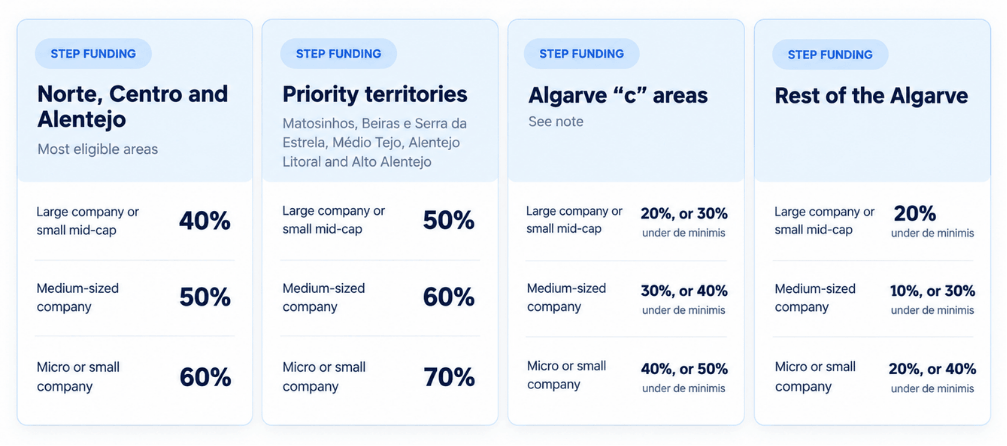 The Algarve “c” areas are the parishes of São Brás de Alportel, Alferce, Boliqueime, Cachopo, Ferreiras, Loulé (São Clemente and São Sebastião), Mexilhoeira Grande, Monchique, Paderne, Pechão, Quelfes, São Bartolomeu de Messines, São Marcos da Serra, Algoz e Tunes, Conceição e Estoi, and Vaqueiros.
Under the de minimis regime, total aid is limited to €300,000 per single undertaking over three years. For example, a small company investing €5 million in an eligible production facility in Matosinhos could potentially benefit from a 70% funding rate. This would represent €3.5 million in theoretical support, subject to approval, eligible costs and the applicable aid rules.
Other important conditions
Companies must demonstrate that they have sufficient financing to complete the investment. At least 25% of the planned equity contribution must be paid in by the time the first grant payment is made. Additional requirements apply to projects that diversify existing production or fundamentally change production processes.
How are applications assessed?
Applications are assessed on four main criteria:
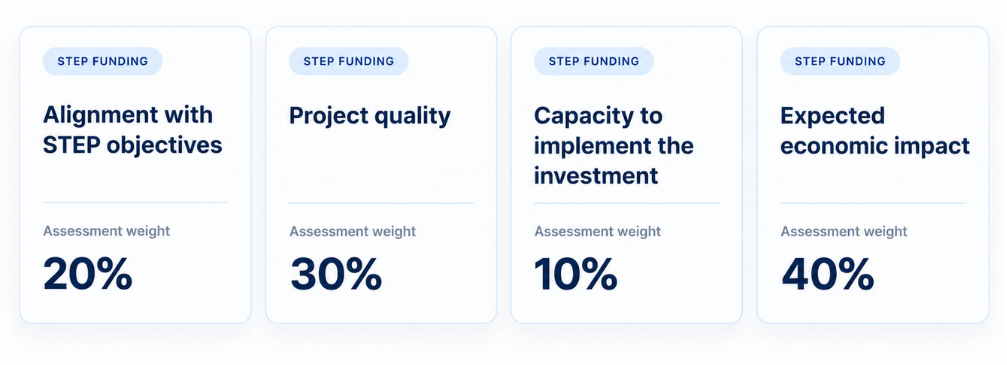
Projects must achieve the minimum required score under the relevant programme. Strong applications clearly explain why their technology is strategic for Europe, how the investment will be implemented and what measurable economic benefits it will generate.
How is the grant paid?
Applications from SMEs are assessed by IAPMEI, while AICEP is responsible for large companies, including mid-caps and small mid-caps. Approved grants are paid in stages, which may include an initial advance of up to 10%, further advances, reimbursements and a final payment.
Companies must document their expenditure and demonstrate progress against the approved project objectives. The final funding amount may be reduced if the project fails to achieve its agreed performance targets.
Eligible investment expenses
The STEP incentive can support several types of expenditure directly connected with establishing or expanding eligible production capacity.
Expenses eligible for all companies
These can include:
- Machinery and equipment: production machinery and the costs necessary to install and operate it, subject to environmental requirements.
- IT equipment and software: technology required for production and business operations within the approved investment.
- Patents and licences: acquisition of intellectual property and technical knowledge.
- Specialised software: standard or custom-developed software required for the project.
Additional expenses for SMEs
Small and medium-sized businesses may also receive support for certain complementary expenses, including engineering services, technical studies, audits, marketing plans and architecture projects. Costs associated with assessing environmental compliance may be eligible up to €15,000. Fees for certified accountants or statutory auditors validating payment claims may be eligible up to €5,000 per project. Together, these additional SME expenses cannot exceed 20% of total eligible project costs.
Construction and refurbishment costs
Construction or refurbishment may qualify when necessary for the innovative investment. The standard limit is 35% of eligible project costs in Norte, Centro and Alentejo, with exceptions in duly justified industrial projects. In the Algarve, the limit can reach 70%. For large companies, intangible assets are limited to 50% of total eligible costs.
Important: Under the 2026 call, expenses incurred before the application date were not eligible, including feasibility studies. Companies therefore need to plan the timing of their investments carefully.
Who can benefit from this incentive?
STEP funding is particularly relevant for companies planning substantial investments in advanced technology manufacturing in Portugal. Potential beneficiaries include semiconductor manufacturers, robotics companies, pharmaceutical and biotechnology producers, manufacturers of critical electronic components and businesses providing specialised services essential to advanced manufacturing.
Both Portuguese companies and international investors establishing eligible operations in Portugal may find opportunities under this type of incentive, provided the applicant satisfies the legal, financial and operational requirements. However, operating in a technology-related sector does not automatically make a company eligible. The investment must contribute to the production of critical technologies or strengthen their strategic value chains. A business simply purchasing artificial intelligence software for its own internal operations, for example, would not normally qualify on that basis alone.
Is STEP funding available for new businesses in Portugal?
Potentially, yes. Projects involving the establishment of a new production facility can qualify, provided the applicant meets the relevant eligibility requirements and can demonstrate sufficient financial and operational capacity.
For international investors, this means the incentive may be relevant when evaluating Portugal as a location for a new industrial or technology-related operation.
Can companies still apply?
The 2026 STEP Productive Innovation call closed on 30 April 2026. Businesses interested in this type of support should check whether a new call or an alternative Portugal 2030 incentive is available before committing to eligible investment expenditure.
Planning a technology investment in Portugal?
For businesses considering a manufacturing or technology investment in Portugal, identifying the right incentive is only one part of the process. The company’s legal structure, investment budget, financing arrangements, accounting records and compliance obligations must also be considered.
Oporto Accounting can help businesses understand the accounting, tax and financial implications of establishing or expanding operations in Portugal.
If you are planning an investment and would like to discuss your company’s situation, reach out through our contact form.