
A Norte 2030 call is funding new permanent, full-time jobs in micro and small businesses and social economy entities in the Ave region, with applications open until 13 November 2026.
The “Apoio à criação de emprego e microempreendedorismo” (support for job creation and micro-entrepreneurship) call, NORTE2030-2026-14, is co-financed by the European Social Fund Plus (ESF+). It pays a non-repayable grant for each new hire, calculated from standard hourly costs per profession, covering 75% of the eligible cost in low-density territories and 65% elsewhere.
Applications opened on 1 July 2026, and the original 30 September deadline has been extended to 18:00 on 13 November. Parallel calls for the Cávado and Terras de Trás-os-Montes regions have already closed.
Programme details
- Funding programme: Norte 2030 – European Social Fund Plus (ESF+)
- Call reference: NORTE2030-2026-14
- Applications open: Until 18:00 on 13 November 2026, via the Balcão dos Fundos
- Eligible beneficiaries: Micro and small businesses and social economy entities in the Ave region
- Type of support: Non-repayable grant
- Funding rate: 75% in low-density territories, 65% elsewhere
- Jobs supported: Up to 3 permanent, full-time jobs per application
- Maximum support period: 24 months per job in low-density territories, 18 months elsewhere
- Indicative budget: €2 million (ESF+)
About the incentive
The measure supports local micro-entrepreneurship by funding new permanent, full-time jobs. The jobs must come from the expansion of an existing micro or small business, or be created in a social economy entity.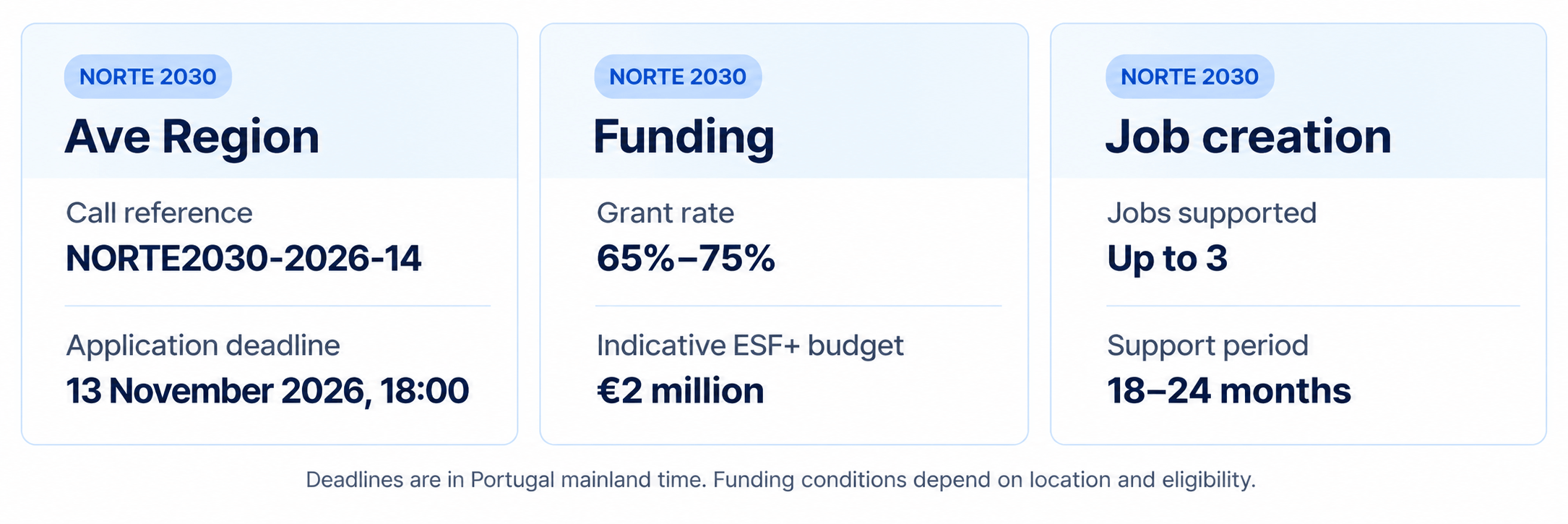
The grant is calculated with simplified costs rather than invoices:
- Staff cost: A fixed hourly rate for the hire’s profession group, set in the call, multiplied by the hours worked (up to 1,720 hours a year).
- Other costs: A 40% flat rate is added, so the total eligible cost equals the staff cost × 140%.
- Grant: A share of that total – 75% in low-density territories or 65% elsewhere – paid by the ESF+ (85%) and the Social Security budget (15%), with the beneficiary covering the remaining 25% or 35%.
For example, a metalworking company outside the Ave low-density territories hiring one skilled metalworker (profession group 72, €10.37 per hour) for 18 months has a total eligible cost of €37,456.44 and receives a grant of €24,346.69. The same hire in a low-density territory, supported for 24 months, receives €37,456.44. The grant falls under the de minimis rules, which limit this type of aid to €300,000 per company over any three-year period.
Eligible activities and beneficiaries
Micro and small businesses with an establishment in Cabeceiras de Basto, Fafe, Guimarães, Mondim de Basto, Póvoa de Lanhoso, Vieira do Minho, Vila Nova de Famalicão or Vizela can apply. They must have filed the 2025 IES and recorded 2025 turnover in the project’s activity code (CAE). Social economy entities with approved 2025 accounts, such as IPSS, cooperatives, mutual associations, misericórdias and foundations, are also eligible.
The project must fall within one of these activities:
- Mining and quarrying (CAE 05 to 09)
- Manufacturing (CAE 10 to 33), with some exclusions in food and drink processing (CAE 10 and 11)
- Accommodation and food services (CAE 55 and 56)
- Education (CAE 85)
- Human health and social work (CAE 86 to 88)
- Arts, sports and recreation (CAE 90, 91 and 93)
- Other service activities (CAE 94 and 96)
Sole traders (ENI) and EIRL are only eligible in low-density territories, and liberal professionals are excluded. The €2 million budget is split equally between companies and social economy entities, and between low-density and other territories.
Who can be hired?
The employment contract must be permanent, full-time and signed after the application is submitted. The job must be done in person at an establishment in the eligible territory, so remote, hybrid and virtual-office arrangements are not accepted.
Eligible hires include:
- People registered as unemployed with IEFP for at least three consecutive months
- People registered with IEFP for any length of time who are aged 35 or under or 45 or over, receive unemployment benefit or the social integration income (RSI), have a disability, are single parents or belong to other listed vulnerable groups
- Inactive or unemployed people with a level 5 to 8 qualification who move from another area to a low-density territory
- Anyone without a Social Security record as an employee or self-employed worker in the previous six months
Managers, partners, board members and cooperative members cannot be supported, nor can the spouses, parents or children of board members or partners. People who were partners or employees of the applicant in the previous 12 months are also excluded.
Main conditions to consider
- Net job creation: When the project ends, total headcount must exceed the average of the 12 months before the application by at least the number of supported jobs.
- Accounting and certification: Organised accounting is required, and companies need IAPMEI SME certification.
- Financial autonomy: Equity must be at least 10% of total assets for companies, and must not be negative for social economy entities.
- Job retention: Each supported job must be kept until three months after the project ends, and a departing worker must be replaced within 90 working days.
- Activity commitment: The beneficiary must keep its activity in the territory for three years after the final payment.
- No double funding: The grant cannot be combined with other public employment support for the same job. It also cannot overlap with direct investment support received during the project, such as Norte 2030, COMPETE 2030, PRR or PEPAC grants.
- Premises: The right to use the premises must cover the project period plus three months.
- Payments: A 10% advance is paid once the first hire starts, followed by reimbursement claims at least every three months.
How are applications assessed?
Applications are scored from 1 to 5 on two main criteria: the project’s socio-economic and environmental added value, and its effectiveness and efficiency. Sub-criteria include local unemployment, the hiring of people from disadvantaged groups, gender equality, environmental practices, the quality of the business or activity plan, the profile of the people to be hired and the applicant’s financial autonomy.
Only applications scoring at least 3.00 are ranked, and funding follows the ranking until the budget runs out. Creating three jobs scores higher than creating one or two. Projects based in municipalities where registered unemployment exceeds the Ave average (5.55% in 2024) by more than one percentage point also score higher. A decision is due within 60 working days of the call closing.
Who can benefit?
The call suits small manufacturers, hotels, restaurants, private schools, clinics, care providers and leisure businesses planning to grow their teams in the Ave region. It is also relevant for IPSS and other social economy entities expanding their services. Employers in low-density territories benefit most, with a 75% grant rate and up to 24 months of support per job.
Need more information?
Oporto Accounting supports micro and small businesses and social economy organisations in checking their eligibility and preparing their applications.
To find out whether your hiring plans qualify before the 13 November deadline, please get in touch through our contact form.