
STEP Productive Innovation for Digital and Biotechnology supports innovative productive investments that manufacture critical digital, deep-tech and biotechnology technologies, or strengthen their value chains, under the EU Strategic Technologies for Europe Platform (STEP). The aim is to stimulate innovative business investment that shifts Portugal’s economic specialisation towards these sectors and strengthens its external competitiveness.
The current call, MPR-2026-10, opened on 30 September 2026 with a budget of €107.95 million: €100 million from COMPETE 2030 and €7.95 million from Algarve 2030 (ERDF). Applications close on 4 January 2027 at 17:00.
Programme details
- Application deadline: 4 January 2027, 17:00 (Lisbon time). The call opened on 30 September 2026.
- Beneficiary entities: Companies of any size and legal form with organised accounting: large companies (including mid-caps and small mid-caps), SMEs, micro-enterprises and startups. Applications are individual.
- Benefit: Non-repayable grant within the STEP regional aid ceilings: up to 70% in Norte, Centro and Alentejo and, in the Algarve, 10% to 40%, or up to 50% under de minimis, depending on location and company size.
- Minimum investment: €3,000,000 in eligible costs per application, which must also stay below €25,000,000 (unless duly justified). The minimum applies both at submission and after review. These limits do not apply in the Algarve.
- Geographic scope:Norte, Centro, Alentejo and Algarve (NUTS II). Algarve investments must be submitted in a separate application. The Lisbon region is excluded.
About the funding
STEP Business R&D&I for Digital and Biotechnology funds innovative productive investments that produce tradable, internationalisable goods and services with high added value and national incorporation, in two STEP sectors:
• digital technologies, including those that contribute to the Digital Decade 2030 targets, and deep-tech innovation;
• biotechnologies, including medicines on the Union list of critical medicines and their components.
Investments must relate to manufacturing final products in these critical technologies, manufacturing specific components and machinery used mainly to make them, producing or recovering critical raw materials, or providing specialised services that are critical to manufacturing the final products.
Indicative digital areas include advanced semiconductors and photonics, artificial intelligence, high-performance, cloud and edge computing, quantum technologies, secure connectivity (5G, 6G and Open RAN), cybersecurity, IoT, digital identity, space-based navigation, advanced sensing, and robotics and autonomous systems. In biotechnology, they include genomics and DNA/RNA technologies, proteins and other molecules, cell and tissue engineering and cell therapies, bioprocessing, gene therapy and viral vectors, bioinformatics and nanobiotechnology.
To qualify as critical, a technology must either bring to the EU internal market an element that is innovative, emerging or cutting-edge (at least two of the three) and has economic potential, or strengthen the value chain and help reduce the EU’s strategic dependencies by meeting at least two of five factors: EU industrial and technological leadership, critical European infrastructure, EU manufacturing capacity for critical raw materials or key components, security of supply, and positive cross-border effects.
Investments must be initial investments: a new establishment, diversification into products or services not previously offered there, a fundamental change in the overall production process, or a new economic activity. The underlying technology must be mature enough for industrial or commercial use, generally TRL 8 or higher.
Projects that already hold a STEP Seal or fall under an IPCEI approved by the European Commission are excluded, as are financial and insurance activities, certain defence activities and gambling. Projects can last up to 24 months, or longer if duly justified.
How it works
Each company can submit up to two applications, provided each is an autonomous operation with its own objectives, investment plan, timeline and indicators. Splitting a single investment to stay below the €25 million cap is not allowed. Work can only start after the application is submitted, except for preparatory work such as feasibility studies, business plans and architecture or engineering projects.
Funding rates. The grant cannot exceed the STEP regional aid map:
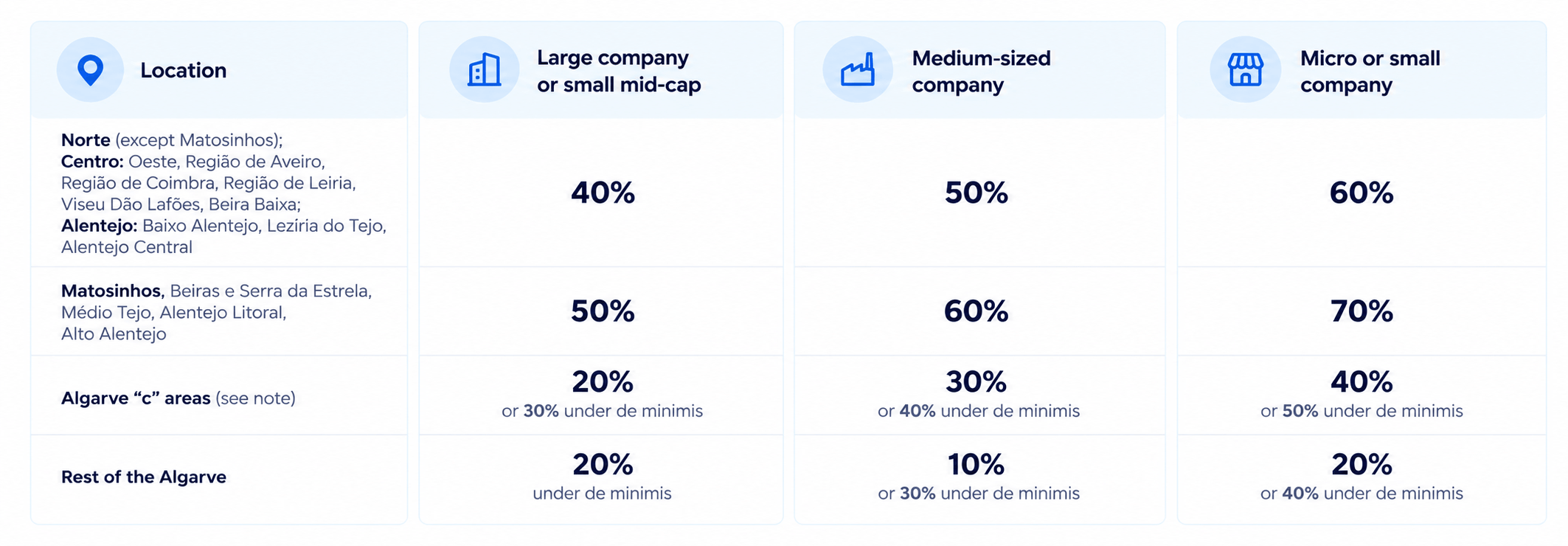
The Algarve “c” areas are the parishes of São Brás de Alportel, Alferce, Boliqueime, Cachopo, Ferreiras, Loulé (São Clemente and São Sebastião), Mexilhoeira Grande, Monchique, Paderne, Pechão, Quelfes, São Bartolomeu de Messines, São Marcos da Serra, Algoz e Tunes, Conceição e Estoi, and Vaqueiros. De minimis aid is limited to €300,000 per single undertaking over three years. In the Algarve, large companies that opt for the General Block Exemption Regulation can only fund initial investment in a new economic activity.
Specific conditions: Diversification projects must invest at least three times the book value of the reused assets. A fundamental change in the production process must cost more than the depreciation of the affected assets over the previous three years. Companies must pay in at least 25% of the planned equity by the first payment.
Selection. Applications are scored from 1 to 5 on four weighted criteria: strategic fit with STEP (20%), quality (30%), execution capacity (10%) and impact (40%). They need a final score of at least 3.50 under COMPETE 2030, or 3.00 under Algarve 2030, with at least 3.00 in each criterion. Scoring rewards projects that cover several STEP technology domains and align with the Digital Decade 2030, the Critical Raw Materials Act and the Union list of critical medicines. Algarve projects are also scored on alignment with the region’s smart specialisation strategy (RIS3).
Decision. IAPMEI analyses SME applications and AICEP those from large companies, including mid-caps and small mid-caps. The managing authorities decide within 90 working days of the call closing, and submissions may be suspended early, with at least 3 working days’ notice. Grants are paid through an initial advance of up to 10%, advances against invoices or guarantees, reimbursements and a final
balance. Under COMPETE 2030, progress reports must accompany each reimbursement claim. The agreed aid rate is kept in full only if the project reaches at least 70% of its contracted output target at completion and 70% of its result targets in the first full year of operation. Shortfalls reduce the rate, and the grant may be revoked if output falls below 40%.
Eligible investment expenses
For all companies
• Machinery and equipment not powered by fossil fuels, plus the costs of installing them and making them operational
• IT equipment, including the software needed to run it
• Intangible assets: national and international patents, licences, unpatented know-how, and standard or custom software
For SMEs only
• Engineering services, studies, diagnostics and audits
• “Do no significant harm” (DNSH) compliance studies, up to €15,000
• Marketing plans, and architecture and engineering projects
• Certified accountant or statutory auditor fees for validating expenses, up to €5,000 per operation
These other expenses cannot exceed 20% of total eligible costs.
Limits and conditions
• Construction or refurbishment, when justified by the innovative activity, up to 35% of total eligible costs in Norte, Centro and Alentejo (higher only in duly justified cases) and up to 70% in the Algarve
• For large companies, intangible assets cannot exceed 50% of total eligible costs
• All expenses must be directly linked to the investment, and work can only start after the application is submitted (preparatory studies excepted)
Who can benefit from this incentive
The incentive suits companies building manufacturing capacity in critical digital, deep-tech or biotech technologies, particularly those that:
• manufacture semiconductors, photonic or electronic components, or computing, connectivity, cybersecurity or robotics equipment;
• produce biotech products, including critical medicines and their components, and advanced therapies;
• provide specialised services that are critical to manufacturing, such as cleanrooms, testing, high-performance computing or clinical trial management;
• have proven technology (TRL 8 or higher) ready for industrial production;
• plan eligible costs of €3 million to €25 million in Norte, Centro or Alentejo, or a project of any size in the Algarve.
Planning an investment in Portugal?
Oporto Accounting can help businesses understand the accounting, tax and financial implications of establishing or expanding operations in Portugal.
If you are planning an investment and would like to discuss your company’s situation, reach out through our contact form.